NPORS vs CPCS: What’s the Difference and Which One Do You Need? (UK Guide)
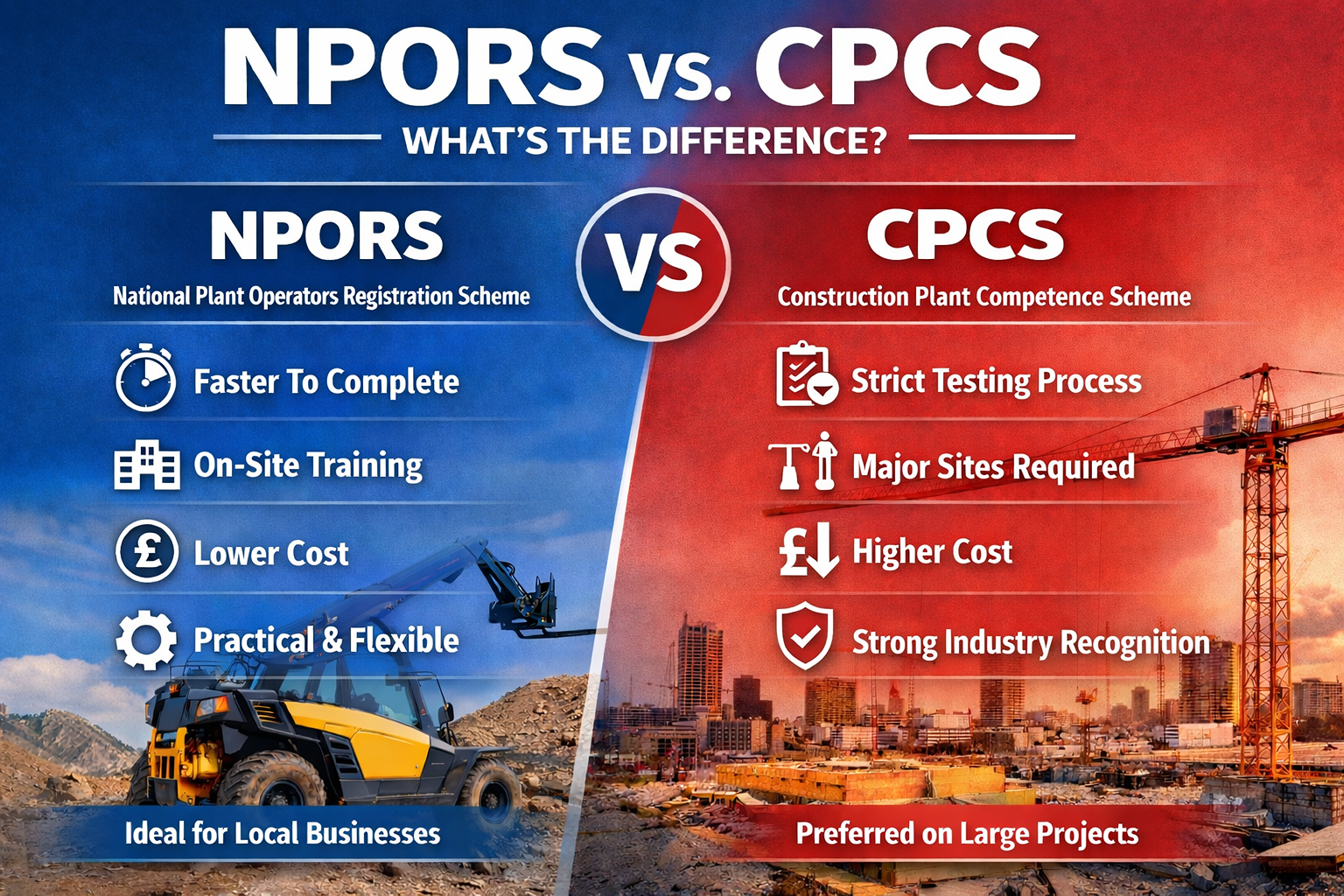
🚧 NPORS vs CPCS – What’s the Difference?
If you’re looking to work in construction or operate plant machinery in the UK, you’ve probably come across two main certification schemes: NPORS and CPCS.
Both prove operator competence — but they are not the same.
👉 Choosing the right one can affect where you can work, how quickly you can get certified, and how much you pay.
🏗 What Is NPORS?
NPORS (National Plant Operators Registration Scheme) is a widely recognised training and certification body in the UK.
It focuses on:
On-site certification
Real-world operating skills
✅ Key benefits of NPORS:
Faster to complete
More flexible (often on-site training)
Lower cost than CPCS
Ideal for companies training staff
🏢 What Is CPCS?
Construction Plant Competence Scheme (CPCS) is another major certification scheme, often associated with larger construction sites.
It focuses on:
Standardised testing
Theory and technical knowledge
Nationally recognised cards
✅ Key benefits of CPCS:
Required on some large construction sites
Strong industry recognition
Structured testing process
⚖️ NPORS vs CPCS – Key Differences
🎯 1. Flexibility
CPCS: Usually requires attending a test centre
👉 NPORS is far more convenient for businesses.
💰 2. Cost
NPORS: Typically more affordable
CPCS: More expensive due to testing structure
👉 For companies training multiple staff, NPORS is often the better value.
⏱ 3. Time to Qualify
NPORS: Faster and more flexible
CPCS: Longer process with separate tests
🏢 4. Site Acceptance
NPORS: Accepted on most sites
CPCS: Required on some large or Tier 1 construction sites
👉 This is the biggest deciding factor.
📚 5. Training Style
NPORS: Practical, hands-on, real-world focused
CPCS: More theory-heavy with formal testing
🎓 Which One Should You Choose?
Choose NPORS if:
You want to get qualified quickly
You need on-site training
You’re working for a local company
You want a cost-effective option
Choose CPCS if:
You plan to work on major construction projects
The site specifically requires CPCS
You’re working with large contractors
📍 NPORS Training in Devon & Cornwall
For most businesses and operators in the South West, NPORS is the most practical and efficient option.
At Tamar Valley Training, we provide:
On-site NPORS training
Small group sizes
Flexible scheduling
Experienced instructors
⚠️ Legal Requirements Still Apply
Regardless of whether you choose NPORS or CPCS, UK law requires that operators are:
Properly trained
Competent
Assessed for the equipment they use
This is enforced by the Health and Safety Executive under regulations such as:
Provision and Use of Work Equipment Regulations 1998
Lifting Operations and Lifting Equipment Regulations 1998
👉 Certification is not optional — it’s a legal requirement.
💡 Can You Convert NPORS to CPCS?
In some cases, experienced operators may move between schemes, but this is not automatic.
You may still need:
Additional testing
Further assessment
👉 It’s always best to choose the right scheme from the start.
❓ Frequently Asked Questions
Is NPORS recognised everywhere?
NPORS is widely accepted, but some large construction sites may specifically require CPCS.
Is CPCS better than NPORS?
Not necessarily — it depends on where you plan to work.
Which is cheaper?
NPORS is generally more affordable.
Can I get trained on-site?
Yes — NPORS training is commonly delivered on-site.
📞 Ready to Get Qualified?
If you’re unsure which certification is right for you, Tamar Valley Training can guide you based on your needs and work environment.
We provide NPORS training in Exeter and across Devon
👉 Speak to Pete today and get the right training booked in.