Telehandler vs Forklift: What’s the Difference?
If you’re looking to work in construction, warehousing, or agriculture, you’ve probably come across both telehandlers and forklifts. At first glance, they might seem similar — both lift and move loads — but in reality, they serve very different purposes.
Understanding the difference isn’t just helpful — it’s essential for choosing the right training, staying safe, and doing the job properly.
What Is a Telehandler?
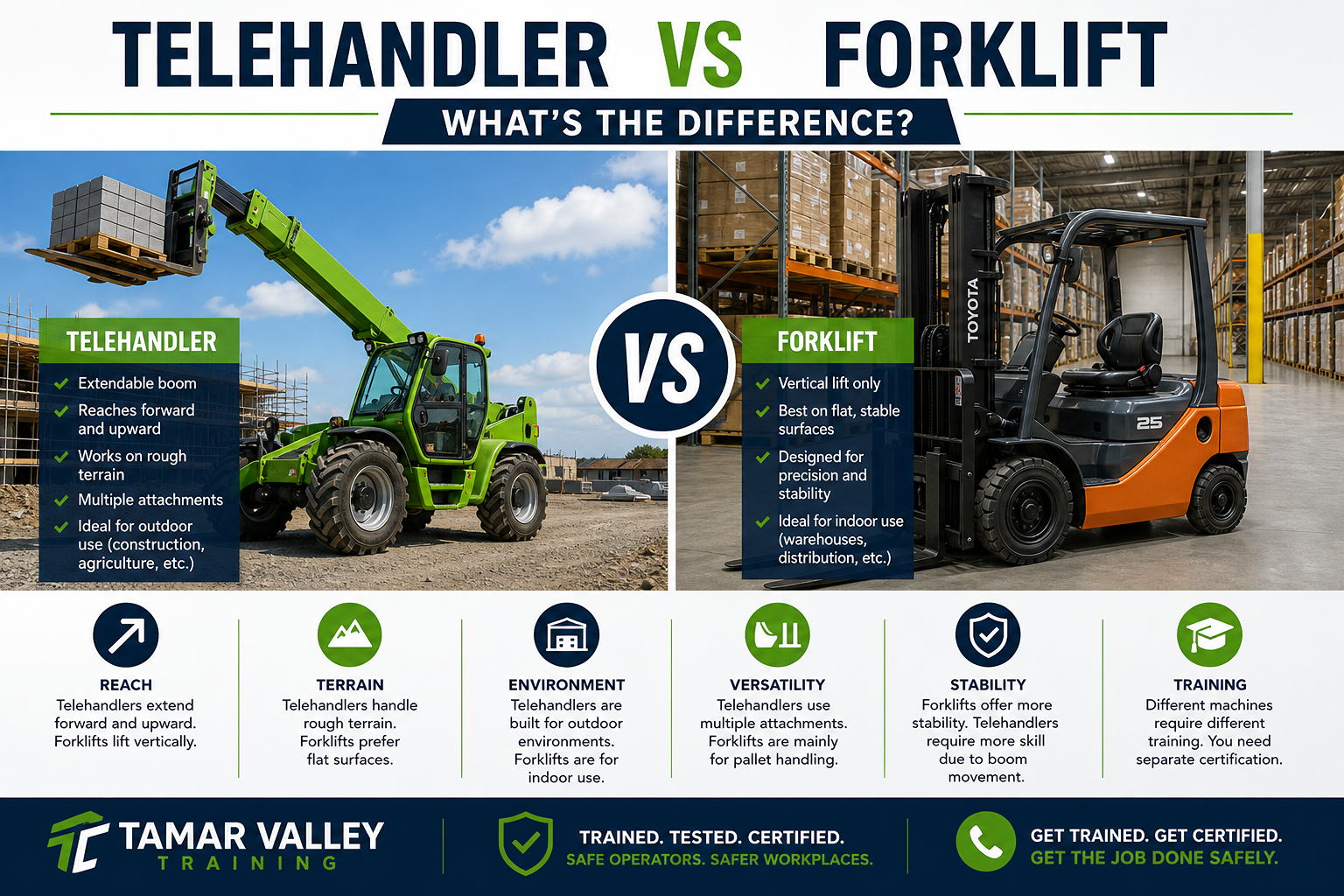
A telehandler (short for telescopic handler) is a versatile lifting machine commonly used on construction sites and farms. It features a telescopic boom that can extend forwards and upwards, allowing it to reach areas a standard forklift cannot.
Key Features:
Extendable boom (forward and upward reach)
Works well on rough terrain
Can use multiple attachments (buckets, lifting jibs, pallet forks)
Ideal for outdoor environments
Common Uses:
Lifting materials to height (e.g. scaffolding, roofing supplies)
Moving loads across uneven ground
Agricultural handling tasks
What Is a Forklift?
A forklift is designed primarily for lifting and transporting loads over short distances, typically on flat, stable surfaces. It uses two forks at the front to lift pallets and materials.
Key Features:
Fixed vertical mast (no forward reach like a telehandler)
Designed for stability and precision
Best suited for indoor or smooth outdoor surfaces
Various types (counterbalance, reach truck, pivot steer, VNA)
Common Uses:
Warehouse operations
Loading and unloading deliveries
Stock movement and storage
Telehandler vs Forklift: The Key Differences
FEATURE | TELEHANDLER | FORKLIFT |
|---|---|---|
REACH | Extends forward and upward | Vertical lift only |
TERRAIN | Rough terrain capable | Best on flat surfaces |
ENVIROMENT | Outdoor (construction, farms) | Indoor (warehouses, yards) |
VERSATILITY | Multiple attachments | Mostly pallet handling |
STABILITY | Requires more skill due to boom movement | More stable and controlled |
Which One Is Safer?
Both machines are safe when used correctly — but they come with different risks.
Telehandlers are more complex due to the extending boom, which affects load balance and stability.
Forklifts are more compact but still pose risks like tipping or load drops if used incorrectly.
That’s why proper training is critical. UK guidance from the Health and Safety Executive makes it clear that operators must be trained and competent on the specific equipment they use.
Do You Need Different Training?
Yes — and this is where many people get it wrong.
You cannot use a telehandler licence to operate a forklift, or vice versa. Each machine requires its own certification because the operation, risks, and handling are completely different.
At Tamar Valley Training, we offer:
Forklift training (counterbalance, reach, pivot steer, VNA and more)
Telehandler training (including suspended loads and rough terrain)
Courses for novice, experienced, and refresher operators
Which One Should You Choose?
It depends on your work environment:
Choose a telehandler if you’re working in construction, agriculture, or need reach and flexibility.
Choose a forklift if you’re working in a warehouse, distribution centre, or yard with flat surfaces.
If you’re unsure, think about the job you want — not just the machine. The right training should match your career direction.
Final Thoughts
Telehandlers and forklifts might overlap in function, but they are built for completely different roles. Choosing the right one — and getting properly trained — can make a big difference to your safety, job prospects, and confidence on site.
If you're ready to get qualified or want advice on the best course for you, get in touch with Tamar Valley Training today.